Beyond M&A

    From Code to Cash · Our method

    Most technology diligence ends at the report. Ours doesn't.

    We built the Code to Cash Method because a finding nobody acts on is worth little to an investment committee that has already signed. One team, one thread, from first look to exit.

    It has two layers. Code to Cash is the commercial arc, tech due diligence for investors and buyers. MERGE is the engine that runs once a deal is real, carve-outs included.

    The arc

    Four stages.

    What happens, and when. The numbers behind each stage come from the engine below.

    Inside stage 02

    Twelve scope areas.

    Sized to the deal and written for an investment committee rather than an engineering team. Every area comes back with a number, an owner and a recommendation, not a risk list.

    How a diligence runs
    • 01

      Team and leadership

    • 02

      Commercial model

    • 03

      Product and tech roadmap

    • 04

      AI: use and defensibility

    • 05

      Technology and architecture

    • 06

      Cybersecurity

    • 07

      Operations

    • 08

      Development processes

    • 09

      Customer onboarding

    • 10

      Back-office IT

    • 11

      Technology spend

    • 12

      Integration readiness

    The engine, inside stage 03 and stage 04

    MERGE.

    An end-to-end integration method, not a set of gates. Diligence does not stop when planning starts, it carries into the deal. And what one deal teaches goes straight into the next one.

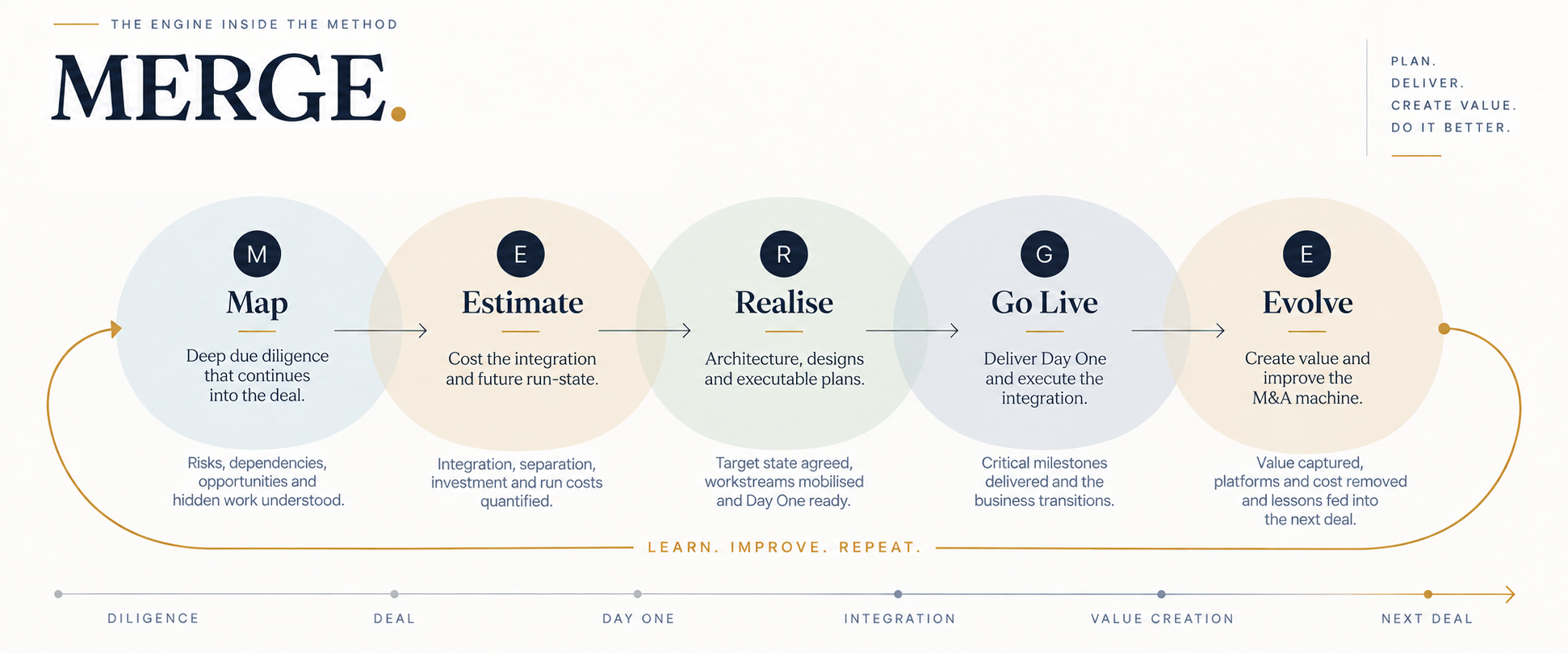
    Map, Estimate, Ready, Go, Evolve. Each step has a stated outcome, an owner, a date and a number attached.

    The MERGE method: Map, Estimate, Ready, Go, Evolve. Map continues across Estimate and Ready, and Evolve feeds back into Map for the next deal.
    1. Step 1

      Map

      Risks, dependencies and hidden work understood

      Keeps running through Estimate and Ready

    2. Step 2

      Estimate

      Integration, separation and run costs quantified

    3. Step 3

      Ready

      Target state agreed and Day One ready

    4. Step 4

      Go

      Milestones delivered and the business transitions

    5. Step 5

      Evolve

      Value captured and lessons fed into the next deal

    Learn. Improve. Repeat.

    Diligence / Deal / Day One / Integration / Value creation / Next deal

    1. M
      Step 1

      Map

      Deep diligence that continues into the deal. The outside-in assessment and the twelve scope areas, on both sides of the line, including what a seller has not separated yet.

      Outcome. Risks, dependencies, opportunities and hidden work understood.

      The number that matters. Unbudgeted spend uncovered before you commit.

    2. E
      Step 2

      Estimate

      Cost the integration and the future run-state. Every line built from the ground up, standalone and integrated, with an owner and a date against each.

      Outcome. Integration, separation, investment and run costs quantified.

      The number that matters. A defensible cost to run and a cost to separate, carried into the deal model rather than discovered after signing.

    3. R
      Step 3

      Ready

      Architecture, designs and executable plans. Target architecture, sequencing, Day One scope, and the people who will run it.

      Outcome. Target state agreed, workstreams mobilised and Day One ready.

      The number that matters. A blueprint the board can approve, before the go-ahead.

    4. G
      Step 4

      Go

      Deliver Day One and execute the integration. The systems, the teams and the savings the deal was priced on, run by the people who wrote the report.

      Outcome. Critical milestones delivered and the business transitions.

      The number that matters. Milestones hit against the dates set at Estimate.

    5. E
      Step 5

      Evolve

      Create value and improve the M&A machine. Consolidation, spend taken out, AI put to work, exit from transitional services, and what this deal taught fed into the next one.

      Outcome. Value captured, platforms and cost removed, lessons fed into the next deal.

      The number that matters. Opex removed and platforms retired, measured against the Map.

    Track record

    Integrations and separations we have run.

    The challenge in each case, and what we actually did about it. Some of this work goes back years. It is included because the pattern has not changed: the estate is never the hard part, the two teams are.

    IRIS Software Group

    The challenge

    Around 30 acquisitions over a decade, with no M&A process in place when we started.

    What we did

    We worked alongside the internal team to build the process deal by deal, and became part of that team rather than a supplier to it.

    Morgan Sindall and Connaught

    The challenge

    An acquisition out of distress, with immovable deadlines.

    What we did

    We helped the internal team set a Day 1 scope that could actually be delivered in the time available, then delivered it with them.

    Gala and Coral

    The challenge

    A divestment where the original programme had stalled.

    What we did

    We re-planned the programme with the people already running it, and put the sequencing back on a footing the board could sign.

    Norton Rose and Fulbright

    The challenge

    Two global multi-site firms merging into a centralised directory.

    What we did

    We worked with the architecture and security teams to land a design every global stakeholder bought into.

    British Land and Broadgate Estates

    The challenge

    Business requirements that kept moving during the separation.

    What we did

    We built the relationships inside the technical teams so they could deliver a complex and risky cloud-to-cloud migration with us.

    Equiniti and Hazel Carr

    The challenge

    Disparate data locations, with post-merger work still open years after the acquisition.

    What we did

    We rebuilt communication across the teams so they could finish the key upgrades and retire the legacy software and hardware.

    Equiniti

    The challenge

    A sustained acquisition programme, with diligence and integration running back to back.

    What we did

    Across 50 plus diligences and integrations we worked as part of their team, and left the process stronger than we found it each time.

    Your team

    The challenge

    The deal on your desk right now. A target you cannot see inside, an integration priced on assumption, or a carve-out nobody has costed from the ground up.

    What we would do

    Run MERGE on it. Map what is there, cost it, and stay on to deliver the number we put our name to.

    Talk to us about your deal

    One lens

    Every stage runs through TIE.

    Truth, Immediacy, Efficacy. It is how we decide what to say, when to say it, and what to recommend.

    T

    Truth

    An honest verdict, including the one that kills the deal. No varnish in the report, no spin in the room.

    I

    Immediacy

    Same-day responses while your process is live, not a silence that breaks at the readout.

    E

    Efficacy

    The effective route, not the cheapest or the fastest. Every finding lands with a number, an owner and a recommendation.

    Where we are different

    Stage 03 is the reason people keep us.

    Integration is the practice we are built around, not an add-on sold after the fact: Day 1 readiness, exit from transitional services, consolidation, and the savings and gains the deal was priced on. The people who wrote the report deliver the plan in it.

    And because integration fails on people before it fails on platforms, the Kolbe people work runs inside it rather than beside it.

    Post-Merger Integration

    Ten a month

    Diligences we take on. Quality over quantity.

    200+

    Deals assessed in a decade.

    2

    Fully green reports, ever.

    The practices behind the stages.

    01

    You're here when

    You have more targets than diligence budget, and no way to tell which ones deserve the spend.

    Pre-deal Assessment

    Outside-in business assessment

    An outside-in read of a target's technology, team and market signals, before you commit to full diligence. Built for corporate development teams triaging a pipeline, and for investors sizing a target early.

    Read more

    Deliverables

    • Outside-in technology and digital footprint analysis
    • Hidden risk signals from public and proprietary sources
    • Commercial red-flag triage report
    • Go / no-go recommendation with confidence levels
    02

    You're here when

    You're buying into a sector nobody in the room can technically judge, and the IC needs an opinion it can price.

    Technology Due Diligence

    Commercially-focused, PE-fluent

    Twelve scope areas, sized to the deal. We start with the foundations, so what we recommend is something the company can actually implement, and every finding carries a cost, an owner and a date. Our partners have run global technology functions, and the integration is costed here, before you sign.

    Read more

    Deliverables

    • Scope sized to the deal, not a blanket review: people, process, platform, security, data, AI, resilience, scalability, obsolescence risk, cost, roadmap
    • A report non-technical readers can use, written for the investment committee
    • A costed roadmap: every recommendation with a cost, a timing and an owner
    • Recommendations that drop into a 100-day plan, plus carve-out and integration risk
    • Architecture, code, IP ownership and how replicable the technology really is
    • AI and generated code: what was built with generative tooling, who owns the output, and what it costs to run and maintain
    03

    You're here when

    The thesis leans on AI, and nobody in the room can tell you whether the position holds for twelve months.

    AI in the Deal

    Judgement, not a checklist

    AI in a deal behaves like a Rubik's cube. Four faces move at once and turning one turns the others: what is running today, what it could become, what competitors and customers are building instead, and how quickly a defensible position becomes a commodity one. A target that looks strong at signing can lose its place a month after close. This practice exists because that call takes judgement, and someone has to put their name to it.

    Read more

    Deliverables

    • Capacity today: what is actually in production, what it costs to run, and who owns it
    • Potential: what this estate could become, and what the value-creation plan is quietly assuming
    • Disruption from outside: competitors shipping the same capability, and customers building their own
    • Decay: how long the position holds, and what has to be true for it to still be worth something at exit
    • Governance sized to the business: EU AI Act, ISO 42001, model cards and data governance
    • A costed view, so the AI story arrives as an opinion the investment committee can price
    04

    You're here when

    You're going to market, and the technology story is about to be tested by someone who does this for a living.

    Sell-side & Vendor Diligence

    Own the technical narrative before a buyer takes it from you

    Vendor technology diligence, run the way a buyer would run it, with time left to fix what it finds. We surface every risk before an acquirer does, reframe each one as a costed remediation roadmap, and prepare the management team for the room. Then we stay through investor Q&A to close.

    Read more

    Deliverables

    • Vendor tech DD report in buyer format, written to survive a buyer's own diligence
    • Costed remediation roadmap: every gap with a price, a timing and an owner
    • Management preparation for the investor room, including the questions that land hardest
    • AI narrative that stands up to scrutiny rather than inviting it
    • Investor Q&A support through to close
    • A clear read on what to fix now, what to price in, and what to simply disclose
    05

    You're here when

    The deal closed, the plan exists on a slide, and nobody internally has the time or the scars to run it.

    Post-Merger Integration

    The practice most advisers don't have

    This is the work we are built around. For repeat acquirers and larger groups, integration is where the deal is either delivered or quietly lost: Day 1 readiness, exit from transitional services, carve-out separation, platform consolidation, and the savings and gains the deal was actually priced on. We run it alongside management, with the people who wrote the diligence, and we bring interim leadership when there is no bench to do it.

    Read more

    Deliverables

    • Day 1 readiness: what must work on the first morning, and who owns each piece
    • Transitional service exit and carve-out separation, sequenced and costed
    • Platform and back-office consolidation (see Ascend)
    • The savings and gains tracked against the plan the deal was priced on
    • Interim CTO, CIO and CPO leadership while the permanent team is built
    • Spend taken out through the hold, and exit readiness at the end of it
    06

    You're here when

    On paper it's integrated. Inside it's still Them and Us, and the people who hold the knowledge are the ones edging towards the door.

    People & Kolbe Practice

    The half of integration that fails first

    This is Post-Merger Integration seen through the people who have to deliver it. Technology integration fails on people, not platforms. Using Kolbe assessments and decades of integration experience, we map team strengths, predict friction, and design the structure that makes the deal thesis deliverable. It runs alongside the integration programme, not separately from it.

    Read more

    Deliverables

    • Kolbe assessments for leadership and tech teams
    • Merger team mapping & friction prediction
    • Role fit between an entrepreneurial founder-CTO and a governed operator
    • Restructure and operating model design
    • Retention planning for the people who hold the knowledge
    07

    You're here when

    The value-creation plan assumes AI. What exists is a demo nobody would let near a customer or a diligence room.

    Bespoke AI for Portcos

    AI that survives the next diligence

    Most portco AI is a demo that never reaches production. We build the opposite: bespoke AI applications scoped to a specific value-creation hypothesis, engineered to PE governance standards, and documented to survive the next Tech DD. Every decision the model makes is logged, explainable and defensible to regulators, auditors and acquirers.

    Read more

    Deliverables

    • Data readiness: lineage, licensing, governance and AI usage policy
    • PE-grade architecture: model routing, evals, observability, human-in-the-loop
    • Bespoke build aligned to one clear value-creation hypothesis
    • Taking a generated prototype to production: ownership, testing, security and support
    • Run-the-app: monitoring, cost controls, model cards and exit-ready documentation

    The language we use

    What the named methods actually mean.

    All the questions in one place

    What is the Code to Cash Method?

    The Code to Cash Method is Beyond M&A's four-stage approach to technology in a deal: Assess, Diligence, Integrate, Optimise. One team carries it from first look through to exit.

    What does TIE stand for?

    Truth, Immediacy, Efficacy. Truth is the unvarnished position of the estate, Immediacy is what has to be dealt with now, and Efficacy is whether the plan can be delivered by the team that owns it.

    What are the twelve scope areas?

    Twelve areas covering architecture, code and IP, data, security, infrastructure, delivery, team and operating model, spend, obsolescence, resilience, scalability and AI position. Scope is sized to the deal rather than applied as a blanket template.

    What does Them and Us mean?

    Them and Us is the pattern where an acquired business is integrated on paper but never culturally, so two organisations keep operating inside one company long after completion. Beyond M&A assesses it, predicts the friction and fixes the estate you already own.

    Where to start

    Not sure which stage fits?

    Tell us about the deal — we'll point you to the right combination of practices, fast.