
Accelerate PMI, Part 1: Setting the Scene
This is the first of six articles built from our Accelerate PMI workbook, the material we use in working sessions with integration leaders. Each article takes one tool from the workbook and shows how a Corporate Development team can use it on a real deal. Together they sit alongside our MERGE series, which describes how we run a merger end to end. MERGE is the route. These six tools are what you carry on it.
The series: 1. Setting the scene (this article). 2. The competitive advantage M&A canvas. 3. Strategic interdependence. 4. The Greiner curve. 5. The change curve. 6. The Double Diamond.
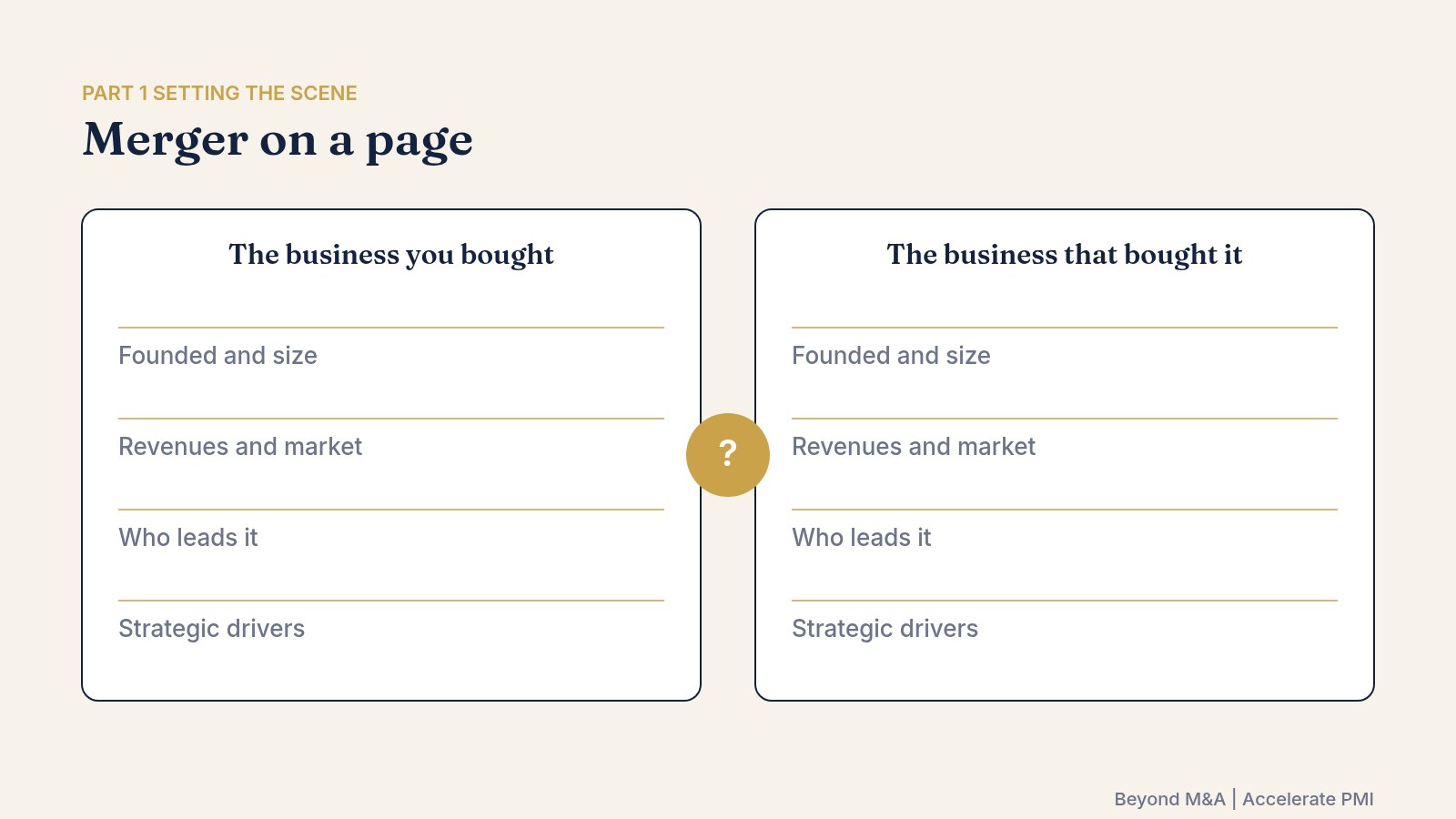
Merger on a page. If you cannot fill both sides in, the integration has not started yet.
1. Every integration runs on assumptions nobody wrote down
Underneath every post-merger integration sits a set of assumptions about how the combined business will grow. Sometimes they are in the investment paper. More often they live in the heads of the three or four people who championed the deal. They say things like "their sales team will sell our product", "we will move them onto our platform in year one" or "the founder will stay and run it as before".
None of these is wrong in itself. The problem is that they are rarely said out loud to the people who have to deliver them. The integration lead inherits a deal with a thesis, a completion date and a budget, but not the reasoning. So the first months are spent rebuilding the logic from fragments: a slide here, a comment in a steering committee there.
The workbook puts the job plainly. The integration leader's role is to uncover those assumptions, turn them into a working model, bring the joint integration team with them and deliver what the shareholders were promised. That starts before any plan is drawn. It starts with setting the scene.
2. Why Corporate Development teams skip this step
Most Corporate Development teams we meet are capable and stretched. Many came from larger organisations where an integration office, a programme team and a bench of specialists did this work for them. Now the resources are thinner and the deal flow is the same or higher. Something has to give, and it is usually the quiet, unglamorous step of writing down what we actually think we bought.
There are three common reasons it gets skipped:
Everyone thinks it is obvious. The deal team has lived with the target for months. To them, the rationale is self evident. To the finance lead who joined the programme last week, it is not.
It feels like going backwards. After signing, the pressure is to move. Pausing to describe both businesses side by side feels like admin.
It surfaces disagreement. Put two leaders in a room and ask them to write the three strategic drivers for the deal, and they will often write different ones. That is uncomfortable. It is also the most useful thing that can happen in the first fortnight.
3. Merger on a page
The first exercise in the workbook is deliberately simple. On one page, set the business you bought next to the business that bought it. For each, capture:
When it was founded and how many people it employs
Its revenues and the market it serves
Who leads it: the chief executive, and the chief operating or finance officer
Its strategic drivers: what it is trying to achieve, in its own words
It looks like a fact sheet. It is not. The value is in the comparison. A forty year old manufacturer with eight hundred people and a fifteen year old software business with ninety people will make decisions differently, measure success differently and react to change differently. Seeing that on one page changes the conversation from "how do we integrate them" to "what does integration even mean between these two".
The strategic drivers line is where most of the work is. The buyer's drivers are usually about scale, capability or market access. The target's drivers, written before the deal, were usually about growth, independence or an exit. Those two sets do not automatically line up. Where they clash, you have found your first integration risk, and you have found it early.
4. Start from a real deal
In our sessions we give teams a choice: use a pre-made scenario, or use a merger they have actually worked on. Almost everyone who chooses their own deal gets more out of it. The tools only become useful when they bite on something real: a founder who would not delegate, a finance system nobody would switch off, a customer base that quietly left in month nine.
We suggest the same for anyone reading this series. Pick one deal, completed or in progress, and run each of the six tools against it as you read. By the end you will have a fairly complete picture of where that integration was heading, and why.
5. Choose your transformation journey
Once the scene is set, the workbook asks you to choose where to focus. Three journeys run through the material:
Competitive capability. What capability did we buy, and what has to be true for it to be a real, working capability in the combined business? This is the subject of Part 2.
Strategic interdependence. How much of the target should we bring into our ways of working, and how much should we leave alone? This is Part 3.
Growth curve. Where is each business on its own growth path, and what crisis is it heading for? This is Part 4.
Two further tools apply to every journey. The change curve (Part 5) is about how people actually experience the integration. The Double Diamond (Part 6) is about defining scope so the programme does not sprawl.
You do not have to pick one journey. But it helps to know which question matters most on this deal. A capability acquisition lives or dies on Part 2. A roll-up of similar businesses lives or dies on Part 3. A founder-led target bought by a mature group almost always needs Part 4.
6. What the workbook is trying to produce
The workbook lists five outcomes. They are worth stating, because they describe what a well set up integration looks like:
A sustainable M&A strategy. Not a one-off justification for this deal, but a way of buying that the business can repeat.
Awareness of the four acquisition approaches. Preservation, symbiosis, absorption and holding, each chosen on purpose.
Identifying crisis. Seeing the growth crisis coming before it arrives.
Modelling the inevitable scope creep. Accepting that scope will grow, and deciding how to control it.
Understanding people's emotional journey. Recognising that an integration is something that happens to people, not just to systems.
None of these is a technology outcome, and that is deliberate. In our experience the technology is rarely the hardest part. The hard part is the decisions that technology depends on.
7. How this connects to merger synchronisation
We describe our approach as merger synchronisation: getting the buyer and the target working to the same plan, at the same pace, from before signing through to the point the combined business runs as one. Setting the scene is where synchronisation starts. If the two businesses are not described in the same terms, on the same page, the plan that follows will be built on two different pictures.
In MERGE terms, this work belongs in Map. Ideally it happens before signing, so the thesis is tested against both businesses as they really are. If it did not happen then, do it now. It is never too late to write down what you think you bought.
8. A practical way to run it
We suggest a ninety minute session in the first two weeks after completion, or earlier if you can.
Invite the deal lead, the integration lead and one senior person from each business. Keep it small.
Before the session, ask each person to write the three strategic drivers for the deal on their own. Do not share them in advance.
In the session, fill in the merger on a page together. Leave the drivers until last.
Reveal the drivers. Group them. Talk about the ones that do not match.
Agree which of the three journeys matters most for this deal, and who owns it.
Write the result up on one page and share it with the integration team that week.
The output is not a plan. It is the brief the plan will be written against.
Questions for your next integration meeting
Could each person in the room write the deal's three strategic drivers, and would they match?
What assumptions about growth sit underneath this deal that have never been written down?
Where do the target's own strategic drivers conflict with ours?
Which journey matters most here: capability, interdependence or growth stage?
Who owns turning the thesis into a working model, by name?
Next week, in Part 2, we look at the competitive advantage M&A canvas: a way of testing whether the capability you bought will actually work inside your business.
Because every deal should be easier than the last.