AI-Native or AI-Washed? What You're Actually Buying.

Part 1 of this series examined the operating models of the advisors you hire. Part 2 turns to the companies you are acquiring. The same AI-native vs. traditional distinction applies — but the stakes are higher, because you are now making a valuation decision, not just an advisory selection.
Listen to the full discussion
AI Rewrites the M&A Playbook — a deep-dive podcast covering all three parts of this series.
The valuation problem cuts both ways
Two errors are common in the market right now, and they look like opposites but they share a root cause: an inability to read the operating model.
Error one — overpaying for AI-washed incumbents. A traditional firm bolts a chatbot onto its existing product, retitles its head of analytics as "Head of AI," and re-prices itself on the basis of a story. The financials are flattered by enthusiasm. The structural model has not changed.
Error two — under-valuing the genuine article. A small AI-native firm has redesigned its operating model from the ground up. Revenue per employee is 5x to 15x the traditional benchmark. But the financials are too young, or the absolute numbers are too small, for a conventional valuation lens to recognise what it is looking at.
The difference between the two is not visible on a pitch deck. Bain's M&A work recommends moving beyond competitor research to include customer interviews and operational prototypes to determine where a target truly sits on the AI impact spectrum. We agree.
Diligence signals that separate signal from theatre
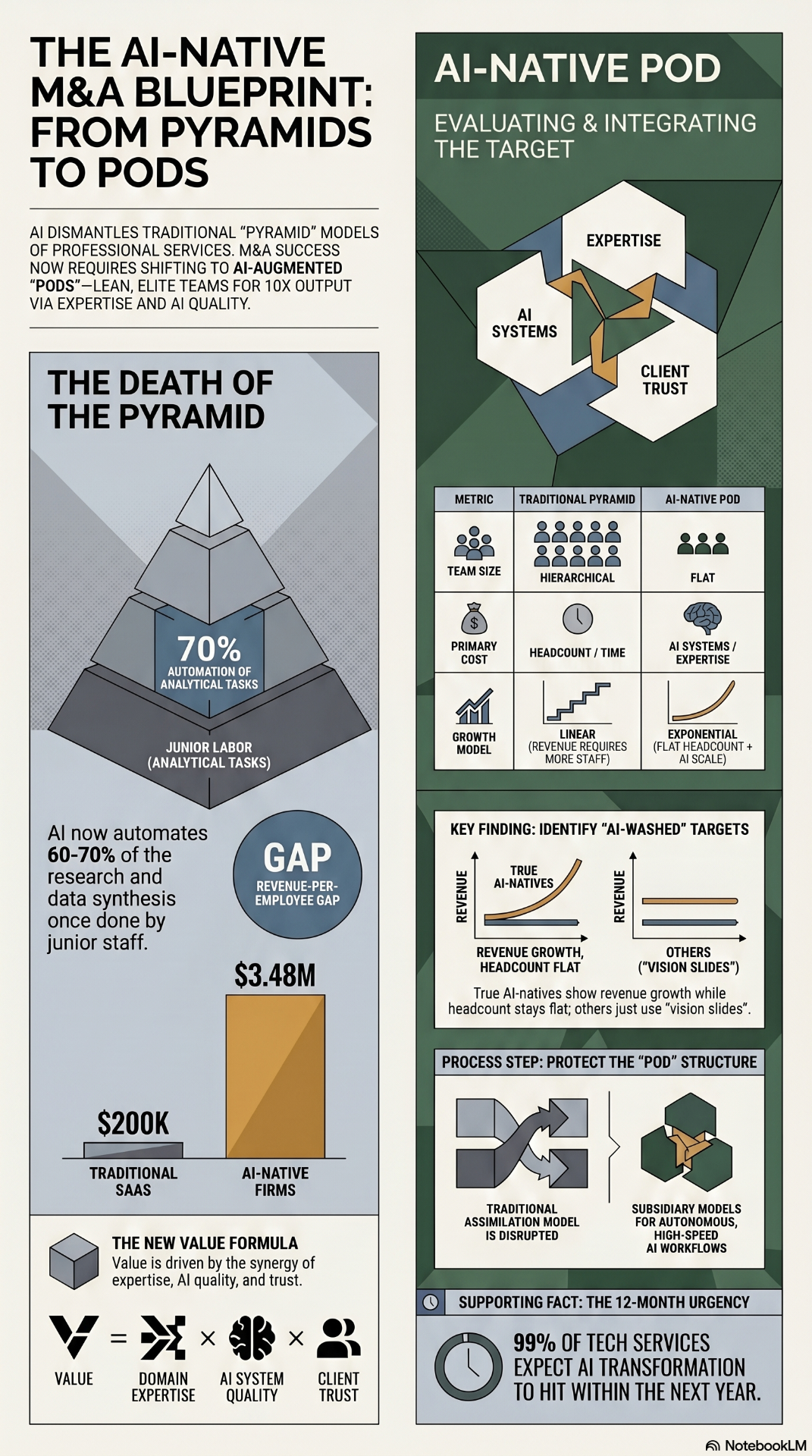
- Revenue per employee — and the trend. AI-native firms break the SaaS rule of thumb decisively. Cursor at $3.3m per head. Midjourney at $12.5m. AI-native top ten averaging $3.48m, against a SaaS average of $200k.
- The roadmap automation target. Explicit, documented, with a date. "We're investing in AI" is not a target. "90% of analytical and operational work automated by Q3" is.
- Where AI lives in the org chart. Is there an AI Facilitator role, or just a vendor list?
- Customer evidence. Do customers describe a different experience, or a familiar one with new buzzwords attached?
- Workflow proofs. Can the team show you an operational prototype end-to-end in 30 minutes? AI-native teams can. AI-washed teams ask for two weeks to "pull something together."
The change-cycle as a diligence lens
Jason Feifer, editor-in-chief of Entrepreneur magazine, has studied how people respond to disruption. His finding: everyone moves through the same four phases, without exception — Panic, Adaptation, New Normal, Wouldn't Go Back.
When evaluating targets, the team's relationship with AI — which phase they are in — is a material diligence signal. A leadership team still in Panic will make defensive, short-term decisions about AI adoption. A team in Adaptation is investible. A team already at Wouldn't Go Back is a structural advantage.
And when integrating, the friction you encounter post-close is rarely "cultural" in the way that word implies. It is rooted in where different people sit on the four-phase cycle. The AI-native team you just acquired is at Wouldn't Go Back. Your integration team is, in many cases, still in Adaptation or Panic. Understanding this gap is the first step to managing it.
What you can accidentally destroy
The most consequential risk in acquiring an AI-native firm is this: the qualities that make it valuable are precisely what traditional integration playbooks destroy.
A ten-person AI-native firm is not a small version of a traditional firm. It is a different operating system. Its value does not live in its brand, its contracts, or even its technology stack in isolation. It lives in the workflows, the people who hold them, and the rhythm of the Pod.
The four integration approaches
- Full Assimilation — fast and inexpensive. Reliably destroys what you bought when the asset is an AI-native operating model.
- Managed Integration — harmonise selected processes (finance, legal, reporting) while protecting delivery autonomy. Viable with deliberate design and active monitoring. Requires someone with accountability to defend the boundary.
- Subsidiary Model — keep it operationally separate. Preserves the operating system; complicates synergy capture.
- Acqui-hire Only — buy the people, let the structure dissolve. Only sensible if the people are the entire asset.
There is no single correct approach. Choose the wrong one and the financial consequences are direct.
M&A has always been a People First endeavour. The reason 80% of M&A deals fail to deliver financial benefits is a failure to engage technology teams as people, not resources. That observation is more true, not less, in an AI-native acquisition context.
Next: the uncomfortable section. Part 3 — The Uncomfortable Bit: Your Own Corp Dev Team → | ← Back to Part 1
The full paper, The Team and Operating Model in the Light of AI, is available as a free download on our Resources page.